Product Description
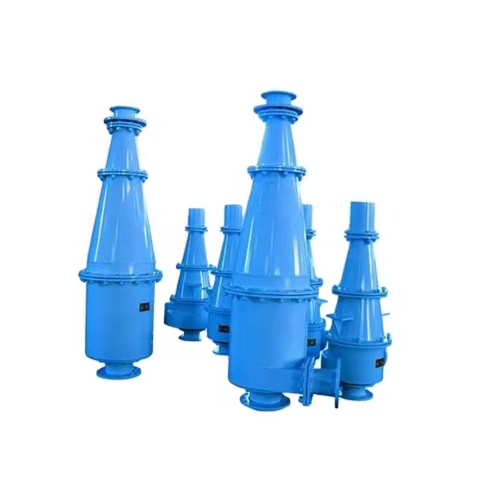
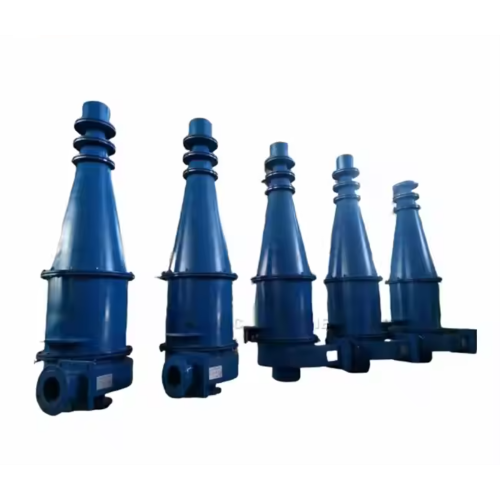
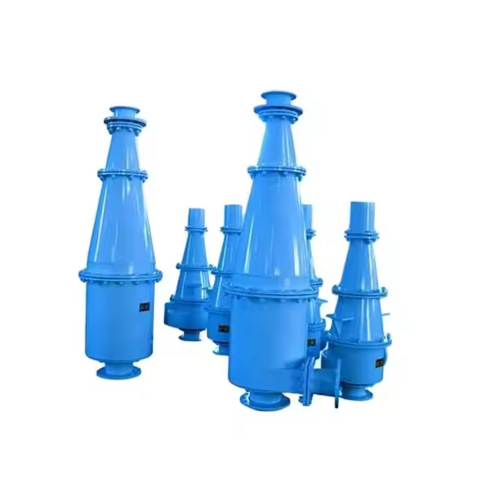
Hydrocyclones
We manufature Hydrocyclones as per customers requirement.
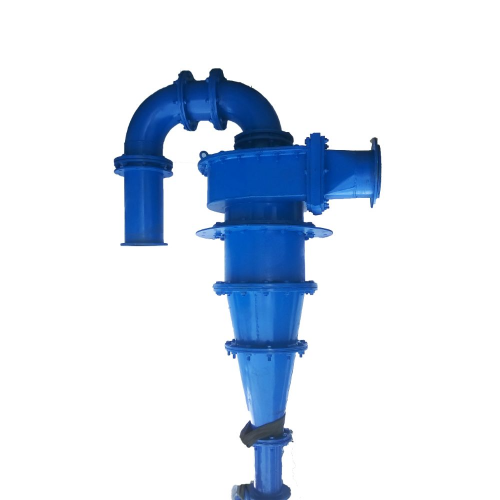
A hydrocyclone is a device to classify/separate or sort particles in a liquid suspension based on the densities of the particles. A hydrocyclone may be used to separate solids from liquids or to separate liquids of different density.
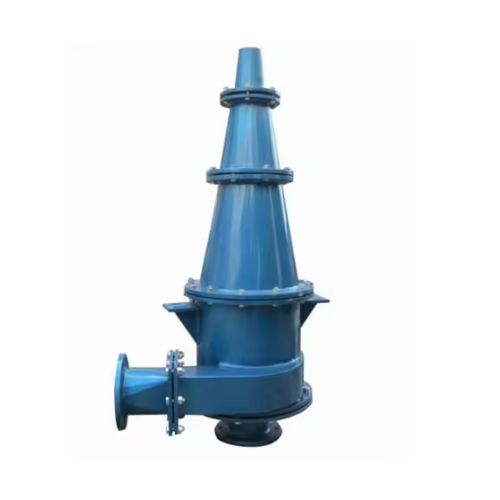
A hydrocyclone will normally have a cylindrical section at the top where liquid is being fed , and a base. The angle, and hence length of the conical section, plays a role in determining operating characteristics.
A hydrocyclone has two exits on the axis: the smaller on the bottom (underflow or reject) and a larger at the top (overflow or accept). The underflow is generally the denser or thicker fraction, while the overflow is the lighter or more fluid fraction.
Internally, centrifugal force is countered by the resistance of the liquid, with the effect that larger or denser particles are transported to the wall for eventual exit at the reject side with a limited amount of liquid, whilst the finer, or less dense particles, remain in the liquid and exit at the overflow side through a tube extending slightly into the body of the cyclone at the center.
Forward hydrocyclones remove particles that are denser than the surrounding fluid, while reverse hydrocyclones remove particles that are less dense than the surrounding fluid. In a reverse hydrocyclone the overflow is at the apex and the underflow at the base. There are also parallel flow hydrocyclones where both the accept and reject are removed at the apex. Parallel-flow hydrocyclones remove particles that are lighter than the surround fluid.
Orithane cyclone distributors
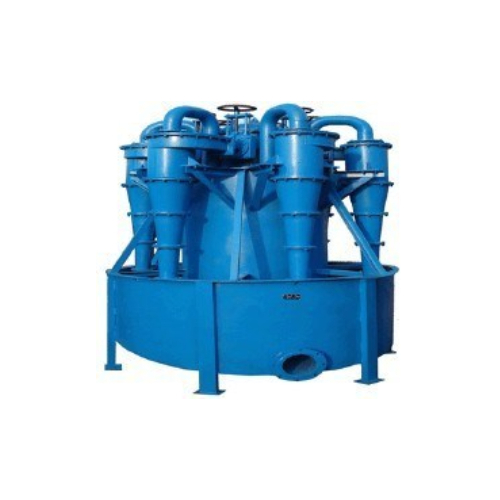
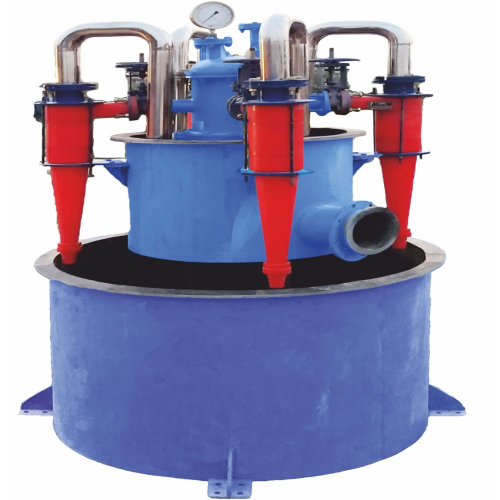
Require 3 connections i.e. feed, overflow discharge and underflow discharge. Compact design to reduce floor area requirement while providing sufficient room for access and maintenance. Isolation valves provided at shoulder height with sufficient access for easy operation. Underflow land\launder installed at floor level for visual inspection of spigot discharge and easy access for maintenance.
Feed distributor
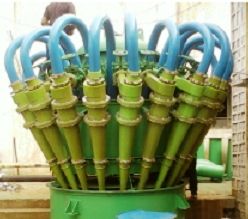
Radial or in-line to ensure equal solids and liquid distribution to each cyclone for equal cyclone performance. 2 to 62 outlets available. All internal surface lined with an abrasion resistant wear liner. Replaceable sole polyurethane wear pad to protect wear liner and increase operating life. Supplied with pressure gauge to monitor cyclone operation.
Cyclones
Designed to accommodate cyclones from 40mm to 900mm. isolation valves provided to enable cyclones to be isolated for maintenance or operational reasons.
Overflow tank/lauder
Individual cyclone overflow discharge into a common overflow. Overflow tank is lined with a suitable abrasion resistant liner. An outlet of sufficient diameter is provided to enable maximum slurry flow rate to discharge under gravity. A removable splash cover is provided to minimize splashing/spray.
Underflow tank/launder
Individual cyclone spigots discharge into a common underflow launder. Underflow tank is lined with a suitable abrasion resistant liner i.e. urethane. Natural rubber or ceramics. A large outlet is provided and the base is angled between 10 and 45 degrees to ensure the dense spigot product can discharge under gravity. A removable splash cover can be provide to minimize any spray/splashing present.
The unique scrolled evolute inlet design.
The heart of the orithane dense medium cyclone.
Through extensive testing and simulations. Orithane process equipment has proven that the scrolled evolute inlet design has a higher capacity when compared to other inlet designs. The scrolled evaluate inlet design substantially reduces vortex finder wear, reducing operating costs and maintaining cyclone efficiency.
Material of construction
Cyclones are available in a wide range of materials depending on cyclone diameter, top size and material being treated.
Available materials are:
Polyurethane
A special abrasion resistant polyurethane which under certain conditions can give three times more life than rubber.
Cast iron
A 27% high chrome cast iron which provides excellent abrasion resistance for most applications.
Silicon carbide
Liners manufactured from nitride bonded silicon carbide which provides superior abrasion resistance for softer and smaller particle applications.
Alumina
Engineered alumina tiles with 94% alumina which is suited to coarse particle high wearing applications.
Hybrid alumina and cast iron
Used in alumina lined cyclones where tramp metal is present. The cone sections are supplied in high chrome cast iron which is better suited to handling tramp metal.
High-efficiency inlet designs
The heart of the orithane cyclone range.
Through extension testing and simulations. Orithane process equipments has proven that both the scrolled evolute and ribbon inlet designs have a higher capacity when compared to other inlet designs. These designs substantially reduce vortex finder wear, thereby reducing operating costs whilst maximizing cyclone efficiency.
General features:
Lightweight overflow elbow
Overflow elbows are made from an abrasion-resistant polymer. That is lightweight, Requires no corrosion protection and is cost-effective a rubber/urethane sleeve is fitted to reduce wear at the vortex finder discharge.
Vortex finders
The scrolled evolute and ribbon inlet designs reduce vortex finder wear to the degree that polyurethane or rubber lined vortex finders can be used cost-effectively.
Loose liners
All wetter surface are lined with 15 or 25mm thick loose replaceable rubber liners. Which have up to three times more life than conventional liners. This reduces operating costs. Maintenance and stock holdings, alternative liners. Such as polyurethane and silicon carbides, are available. For extremely abrasive applications housings lined with 25mm alumina tiles can be supplied
Weep holes prevent damage to housings
Outer housings are fitted with weep holes located in the highest wear areas. Slurry dripping from the weep holes gives an early indication that the liner needs replacing. Preventing housing wear.
HC and HR cyclones incorporate mild steel shell housings. While PC cyclones incorporate lightweight. Rust-resistant, fibre-reinforced composite housings.
Spigot
The spigot is housed in a light weight holder. The design of which enables easy inspection or replacement of the spigot. Inserts are available in polyurethane or silicon carbide.
Cyclone distributors
We offer distributors for larger, multiple cyclone operations. These assembles have been designed to ensure optimum cyclone operation and are extremely compact.
SPECIFICATION
|
Frequency (Hz)
|
50 to 60 Hz
|
|
Voltage (V)
|
220V
|
|
Country of Origin
|
Made in India
|
|
Dust Removal Efficiency (%)
|
50%
|
|
I Deal In
|
New Only
|
|
Model Name/Number
|
ORI-HC
|
Superior Filtration PerformanceThe Hydrocyclone Filter excels in removing sand and silt from water, making it ideal as a pre-filter. Its advanced design utilizes centrifugal forces to efficiently separate particulate matter, ensuring clean water for further filtration or use. With a proven efficiency of 98%, users benefit from remarkably reduced sediment levels and prolonged system life.
Built for Durability and ConvenienceManufactured from high-grade plastic, this filter guarantees strength and resistance to corrosion, all while maintaining a lightweight profile. The compact cylindrical shape and threaded connections allow for simple installation. Manual flush cleaning streamlines upkeep, supporting hassle-free operation in various environments.
FAQs of Hydrocyclones Filter:
Q: How does the Hydrocyclone Filter remove sand and silt from water?
A: The filter uses centrifugal action created within its cylindrical body to efficiently separate sand and silt from water. As liquid flows through the hydrocyclone chamber, particulates are forced outward and settle, while clean water exits through the outlet.
Q: What are the advantages of using a plastic-bodied hydrocyclone filter?
A: A plastic body offers durability, corrosion resistance, and a lightweight design. This makes installation and maintenance easier while ensuring the filter performs reliably under different environmental conditions.
Q: When is manual flushing of the hydrocyclone filter required?
A: Manual flushing should be conducted periodically, depending on sediment load and usage conditions, to clear accumulated particles and maintain optimal filtration efficiency.
Q: Where can this hydrocyclone filter be installed?
A: It can be installed in irrigation, water treatment, industrial, or residential systems wherever pre-filtration of sand and silt is necessary. Threaded ends allow versatile placement within existing piping.
Q: What is the filtration grade of this hydrocyclone filter?
A: The filter functions as a pre-filter with a 120 mesh rating, effectively removing sand and silt before water proceeds to finer filtration stages.
Q: What is the process for cleaning the hydrocyclone filter?
A: Cleaning involves manual flushing, which is done by opening the flush valve to expel collected sediment, helping preserve filtration efficiency and prevent clogging.
Q: How does the filter benefit water systems?
A: By removing sand and silt with 98% efficiency, the filter reduces wear on downstream equipment, protects pumps and valves, and helps maintain water quality, resulting in lower maintenance requirements for the entire system.





 Send Inquiry

 Send Inquiry
 Send SMS
 English
 Spanish
 French
 German
 Italian
 Chinese (Simplified)
 Japanese
 Korean
 Arabic
 Portuguese